Cost breakdown
Clay vs Apollo vs FullEnrich: what 500 contacts a month really costs
A founder asked us for the lowest sensible monthly cost of an outbound stack. We priced the three tools most teams compare, plus six alternatives, and looked at which job each one actually does.
Checked 4 November 2026 · By Tim, Seamline · 7 min read
The question
A founder starting outbound looked at a proposed stack and asked: "Clay is about $495 of the ~$595 monthly cost. At our starting volume, could a lower plan or a different tool do the job?" His setup is common: one person running it, up to 500 new contacts a month, HubSpot as the CRM.
What enrichment has to do
- Find the right people at an account.
- Find a verified work email.
- Find a mobile number, only for priority contacts.
- Get the result into the CRM without duplicates.
Three tools, three different jobs
- Apollo is a contact database of about 240 million people with a prospecting tool on top: search, sequences, a dialer and CRM sync. It finds the people and their emails. Credits don't roll over, and pricing is per user. In the largest public test it found an email for 68% of contacts, 62% verified.
- FullEnrich doesn't have its own database. It asks 25+ providers in turn for the email or mobile of a contact you already know, and charges only when it finds one. In the same test it found 87%, 83% verified.
- Clay is a workbench. It can find companies and people, run its own waterfall, research accounts with AI and, on Growth, write to your CRM automatically. You pay for the orchestration as much as for the data.
In practice: Apollo if you need a list and a place to send from. FullEnrich if your list already comes from somewhere else (your CRM, a signal, LinkedIn). Clay if you need to chain several of those steps automatically.
What it costs
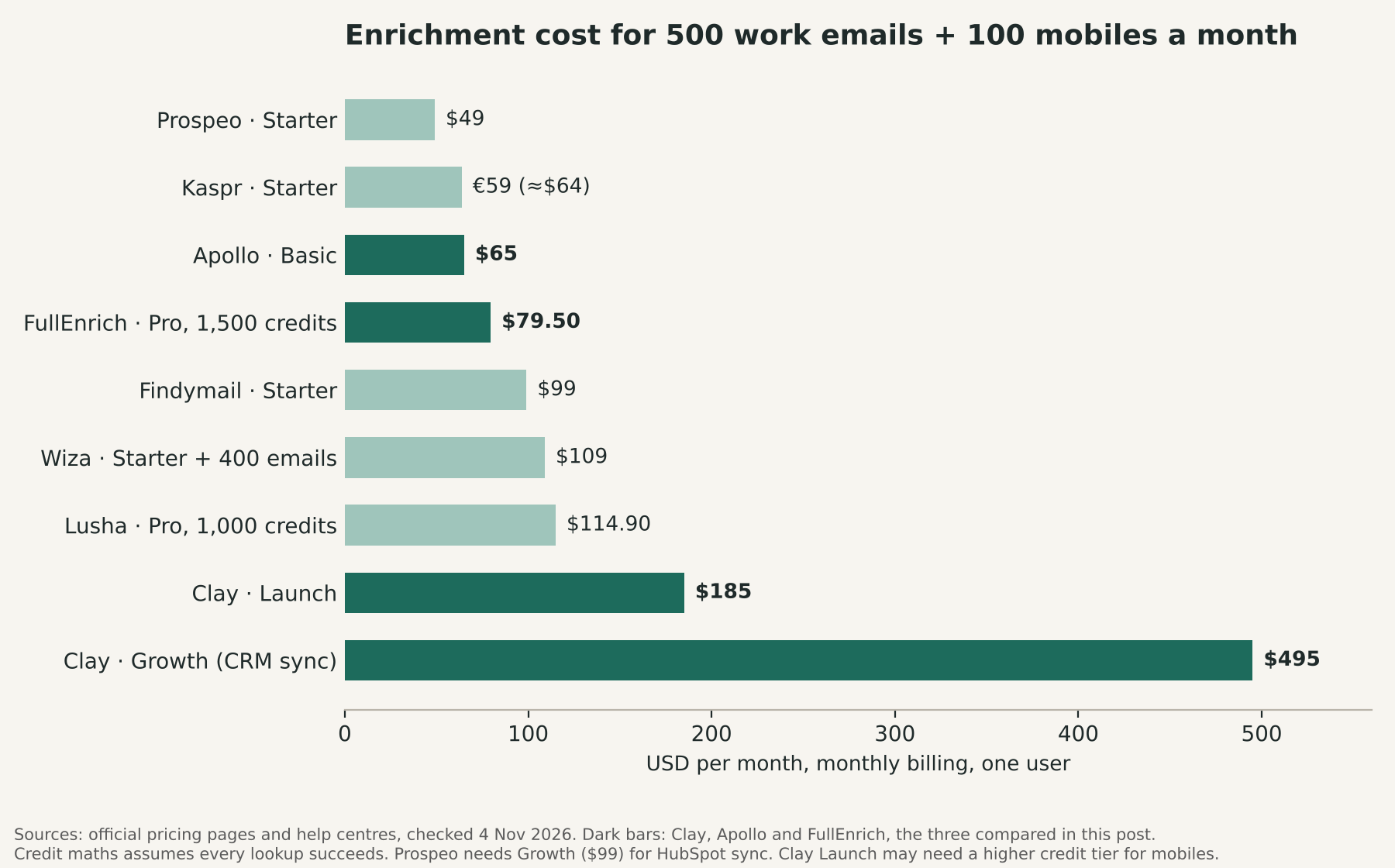
| Tool | Plan (monthly billing) | 500 emails | 500 emails + 100 mobiles | HubSpot |
|---|---|---|---|---|
| Apollo | Basic | $65 (2,500 credits) | $65 (1,300 credits used) | CRM integrations included |
| FullEnrich | Pro | $29 (500 credits) | $79.50 (1,500 credits) | Push to HubSpot on Pro |
| Clay | Launch / Growth | $185 / $495 | $185+ / $495 | Auto-sync on Growth only |
| Prospeo | Starter | $49 (2,000 credits) | $49 | From Growth ($99) |
| Kaspr | Starter | €59 | €59 (100 phone credits included) | — |
| Findymail | Starter | $99 | $99 | All plans |
| Wiza | Starter + extra emails | $109 | $109 | — |
| Lusha | Pro | $69.90 (600 credits) | $114.90 (1,000 credits) | CRM export |
| Hunter | Starter | $49 ($34 billed yearly) | no mobiles | — |
One user. Credit costs: an email is 1 credit everywhere; a mobile is 8 credits on Apollo, 5 on Lusha and 10 on FullEnrich and Prospeo. The maths assumes every lookup succeeds. ZoomInfo and Cognism sell on annual quotes only, so they're not in the table.
Three things the table doesn't show:
- Find rates are below 100%. Getting 500 emails can take around 600 lookups. Tools that charge only for results, such as FullEnrich and Findymail, don't charge for the misses.
- Mobiles cost more. Keep them for priority contacts.
- Rollover differs. FullEnrich keeps unused credits for 3 months on monthly plans, Lusha and Prospeo roll them over, and Apollo's expire at the end of each billing cycle.
Found is not the same as verified
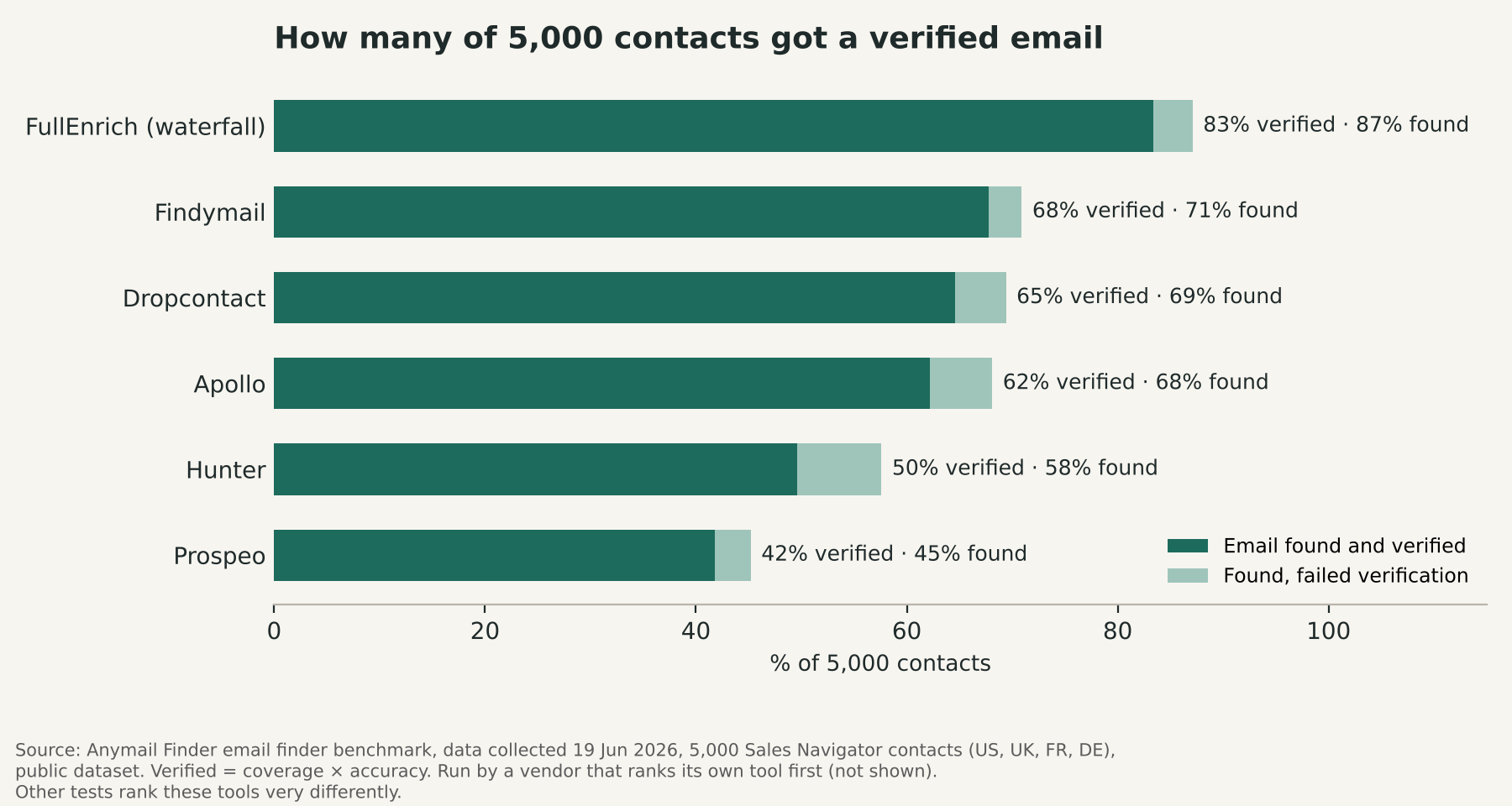
The largest public test is Anymail Finder's benchmark: 5,000 Sales Navigator contacts across the US, UK, France and Germany, every result checked by three verifiers, with a public dataset. Two numbers matter. Coverage is whether the tool returned an email at all. Accuracy is whether that email passed verification. Multiplied together, FullEnrich's waterfall returned a verified email for 83% of contacts (it found 87%), Findymail for 68%, Apollo for 62% and Hunter for 50%.
The caveats are large. Anymail Finder sells its own finder and ranks itself first. Other tests rank the same tools differently: one gives Prospeo 26% where this one gives 45%. Clay isn't in the test, because it resells other providers. And each tool searches different data in a different way.
A waterfall finds more because it asks several providers in turn. It also inherits their mistakes: in a separate test run by Dropcontact, 11.7% of FullEnrich's results pointed to the wrong company domain.
Why verified matters more than cheap
Instantly pauses a campaign by default when bounces pass 5% after 200 sends, and recommends keeping hard bounces at or below 2%. Gmail expects bulk senders to stay under 0.3% spam complaints. A cheap email that bounces costs more than an expensive one that lands, because a burned domain takes weeks to recover.
When Clay is worth it
Clay is a different product, not an overpriced one. You pay for a workbench that chains steps together: find the company, find the people, run an email waterfall, validate, and add a mobile only for certain titles. Growth adds automatic CRM sync and triggers.
It earns its price when your volume is well past a few hundred contacts a month, when you want signals to trigger actions automatically, or when someone non-technical needs to change the flows. If your own process already writes to HubSpot with duplicate checks, the Growth premium mostly buys convenience.
The whole stack
| Monthly billing | With Apollo | With FullEnrich | With Clay Launch | With Clay Growth |
|---|---|---|---|---|
| HubSpot Sales Hub Starter, 1 seat | $20 | $20 | $20 | $20 |
| Enrichment (500 emails + 100 mobiles) | $65 | $79.50 | $185 | $495 |
| Instantly Growth | $47 | $47 | $47 | $47 |
| Google Workspace, 3 inboxes (Flexible) | ~$25 | ~$25 | ~$25 | ~$25 |
| Sending domains, 2 | ~$2 | ~$2 | ~$2 | ~$2 |
| Claude Pro | $20 | $20 | $20 | $20 |
| Total | ~$179 | ~$194 | ~$299 | ~$609 |
Before VAT. Annual billing lowers most lines. Claude Pro doesn't include API usage; an automated pipeline pays for API calls separately.
If you use Apollo's own sequences instead of a separate sequencer, you can drop Instantly ($47) and get to about $132. Many teams keep a dedicated sequencer for inbox rotation and deliverability controls, so test both.
Two notes for European contacts
Findymail's mobile finder excludes EU contacts, and Dropcontact doesn't find mobiles. France's data protection authority (CNIL) fined Kaspr €240,000 in December 2024 over how it collected LinkedIn contact details; in March 2026 it closed the order after Kaspr deleted that database and stopped collecting from LinkedIn. In Germany, unsolicited commercial email generally needs prior express consent, including B2B, with a narrow exception for existing customers. Check the rules for each market before you buy data for it.
What we'd do at 500 contacts a month
- Decide which job you need first: a list (Apollo), emails for contacts you already have (FullEnrich), or an automated chain (Clay).
- Run the same 100 of your own target contacts through two tools before you commit. It costs under $100 and tells you more than any benchmark.
- Move to Clay past about 1,000 contacts a month, when you need automatic triggers, or when a non-technical operator needs to own the flows.
Method and sources
Prices checked 4 November 2026 on official pricing pages and help centres, monthly billing, one user. Credit maths assumes every lookup succeeds.
Sources
- Apollo
- Clay
- FullEnrich
- Prospeo
- Lusha
- Findymail
- Hunter
- Wiza
- Kaspr help centre
- Instantly
- HubSpot
- Google Workspace billing plans
- Anymail Finder benchmark
- Instantly auto-pause
- Google sender guidelines
- CNIL, Kaspr fine
- CNIL, order closed
- UWG §7
What we don't know
Find rates in your market; how many Clay credits a mobile lookup takes for you; the HubSpot integration details for Kaspr, Wiza and Hunter. No fully independent benchmark exists.
Want the leanest stack for your market?