Architecture
AI agents need clean GTM data: the connected company starts with one layer
Everyone is drawing the same picture: AI tools on top, a governed MCP layer, shared company context, and agents keeping it current. Here is what that picture hides, and why your GTM data has to be right before your agents can be.
Checked 21 November 2026 · By Tim, Seamline · 4 min read
The picture everyone is drawing
A diagram has been making the rounds on LinkedIn. People work in whichever AI tool they prefer: Claude, Codex, Grok, something else. Underneath sits a governed MCP layer. Below that is a "company OS", a shared company context that agents keep up to date. That context is fed by domain layers (GTM, customer feedback, product, people), and each of those sits on a system of record: Salesforce, Zendesk, Figma, Workday.
It's a good picture, and we agree with most of it. It's also the shape we build towards with clients. But the picture hides where the work actually is.
What it gets right
The interface is becoming interchangeable. Your team will use more than one AI tool, and next year it may be a different one. The durable asset is not the chat window. It is the context underneath: which accounts matter, what was promised, what changed last week.
Governance belongs in the middle. A single, controlled layer that decides what each agent can read and write beats giving every tool its own keys to every system.
What the AI agent architecture hides
The bottom row is assumed to be clean. In most companies it isn't. The same customer exists three times in the CRM. ARR in HubSpot doesn't match what Stripe actually billed. Deal stages mean different things to different reps. An agent that reads this data doesn't fix it. It repeats it, faster and with more confidence.
"Continuously maintained by agents" is a write permission. Context that agents update without rules will drift. Each small error becomes the input for the next summary. Agents can propose updates, but the rules for what counts as true need to be explicit: a source, a date, and a person who can approve or reject.
"Governed" needs a definition. In practice it means three things. Read broadly, write narrowly. Log every write with its source. Keep a human approval step for anything that reaches a customer.
Where to start: the GTM and CRM data layer
Not with the whole topology. With one box: the GTM layer, because it touches revenue and its data is usually the messiest.
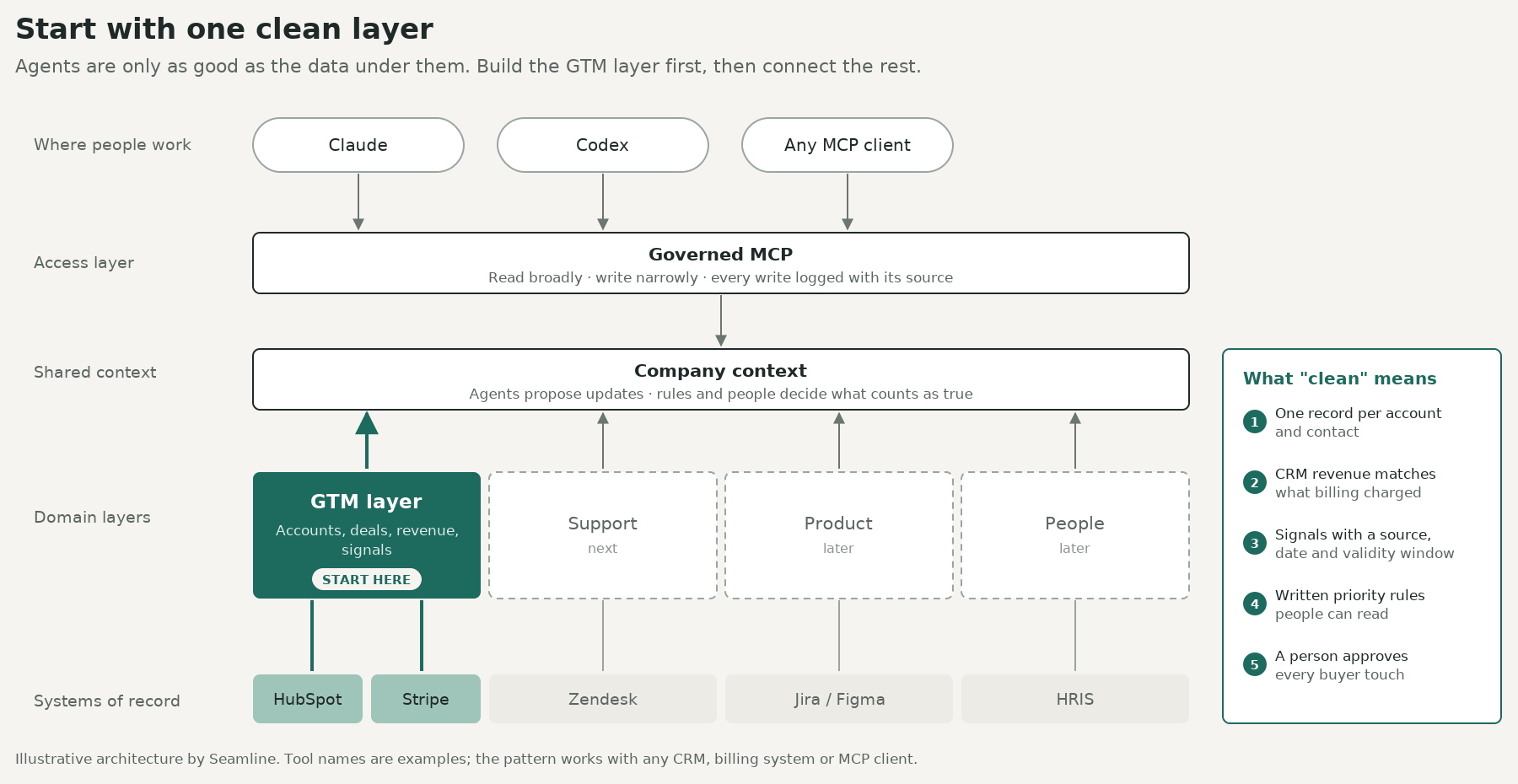
- One source of truth for accounts and contacts. Deduplicate companies, merge contacts, and agree on what each lifecycle stage means. Our company deduplication use case shows how, and our CRM data cleansing service does it for you.
- Reconcile the CRM with billing. If HubSpot and Stripe disagree on ARR, every agent downstream inherits the wrong number. See why HubSpot ARR and Stripe don't match.
- Log signals as evidence, not opinions. Every signal has a source, a date and a validity window, so "this account is in-market" can be checked.
- Use explicit rules before AI judgement. Prioritisation tiers are written as rules people can read and change.
- Only then, expose it through MCP. Start read-only. Add write access one action at a time, each with an audit trail and a human approval where a buyer is involved.
Once that layer holds, the next domain (support, product, people) follows the same pattern. The topology is the destination. The first mile is unglamorous data work, and it decides whether the agents above it are useful or just confidently wrong.
Method and sources
This is an architecture opinion, not a measurement. It is based on our own client work on CRM data, billing reconciliation and signal-based outbound. The diagram is our own illustration; tool names are examples.
Sources
What we don't know
How fast MCP governance tooling matures; how much write access teams will be comfortable giving agents; whether the domain layers end up as separate products or one platform.
If your agents are only as good as your HubSpot, that's where we start: clean CRM data, reconciled revenue and signal-based workflows with a person approving every touch.