Market research
What is an AI SDR, what does it cost, and what do the agents actually do in 2026?
"Fully automated prospecting" is everywhere. We read the product templates, the published results and the pricing.
Checked 4 November 2026 · By Tim, Seamline · 4 min read
What an AI SDR is
An AI SDR is software that does a sales development rep's research and writing: it finds accounts, looks for a reason to reach out, writes the message, sends it and follows up. "Agent" means it takes actions with tools such as a browser, your CRM or your inbox. The real question is how much of that chain runs without someone checking it.
What the products actually do
Take xAI's Grok Bot, in beta since August 2026. It runs on its own cloud computer and connects to your CRM, email, LinkedIn and X. Its official GTM Prospecting bot builds a prioritised list from your ICP, enriches it and drafts the first email and LinkedIn message; outbound messages stay drafts until you confirm. Its Outbound Prospecting bot says it never sends anything without your explicit approval.
When someone posts that their prospecting is fully automated, they've usually removed the approval step themselves or added a sending tool.
What the published results show
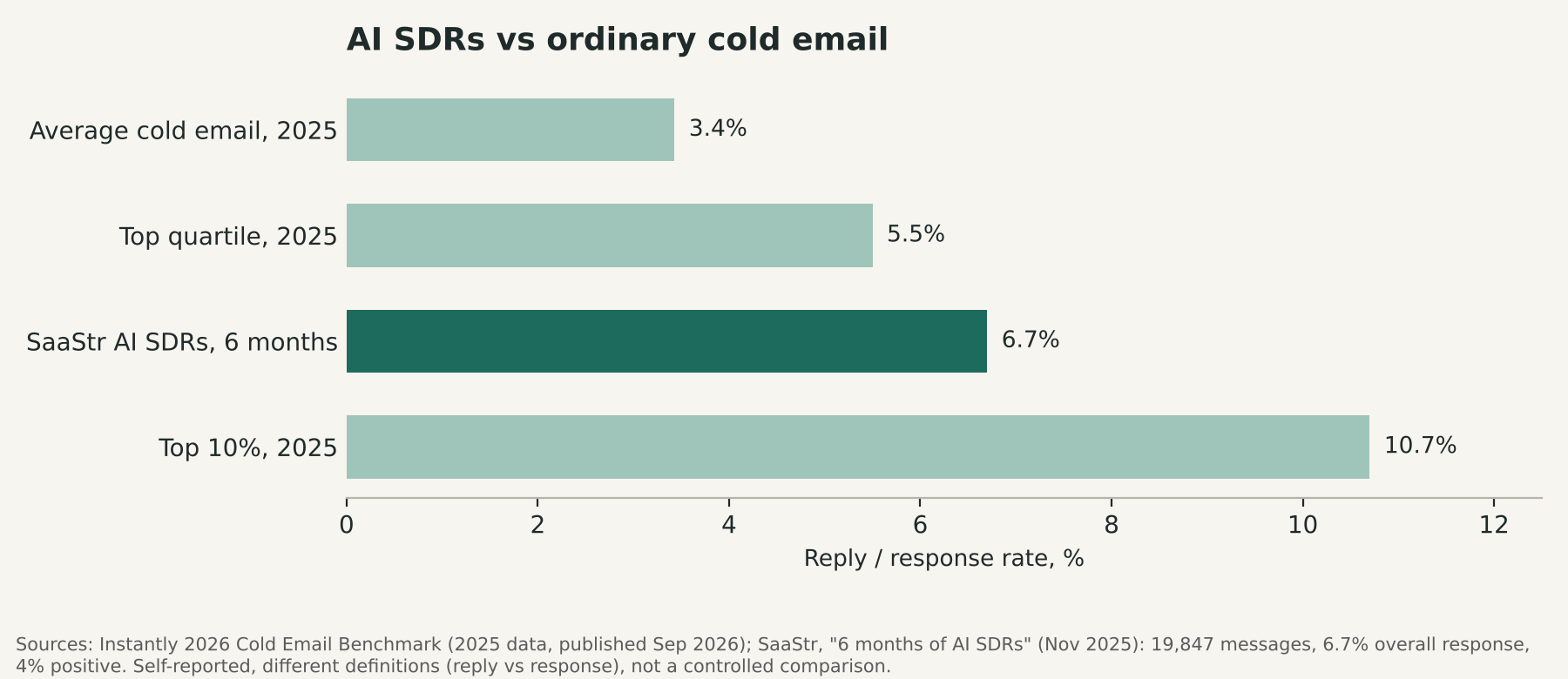
SaaStr runs much of its go-to-market on AI agents and publishes the numbers. In November 2025 it reported six months of AI SDRs: 19,847 messages, a 6.7% overall response rate and 4% positive responses. In October 2026 it reported $4.8M in pipeline sourced via agents and $2.4M in closed-won revenue from agent first touches, run by 3 people and 21+ agents. It puts the total at more than $500K a year in tools, platforms and management time. All of this is self-reported.
For comparison, Instantly's 2025 cold email data puts the average reply rate at 3.4%, the top quartile at 5.5% and the top 10% at 10.7%. A well-run agent setup lands around the top quartile, not above it. The definitions differ (response vs reply), and Instantly notes that no benchmark specific to AI agents exists yet.
What it costs
Published entry prices start at about $500 a month: Salesforge's Agent Frank is $499 a month, billed quarterly, for around 1,000 active contacts. 11x's Alice starts at $3,750 a month, billed annually, and larger plans are custom-priced. Contact data, sending infrastructure and the time to review output come on top.
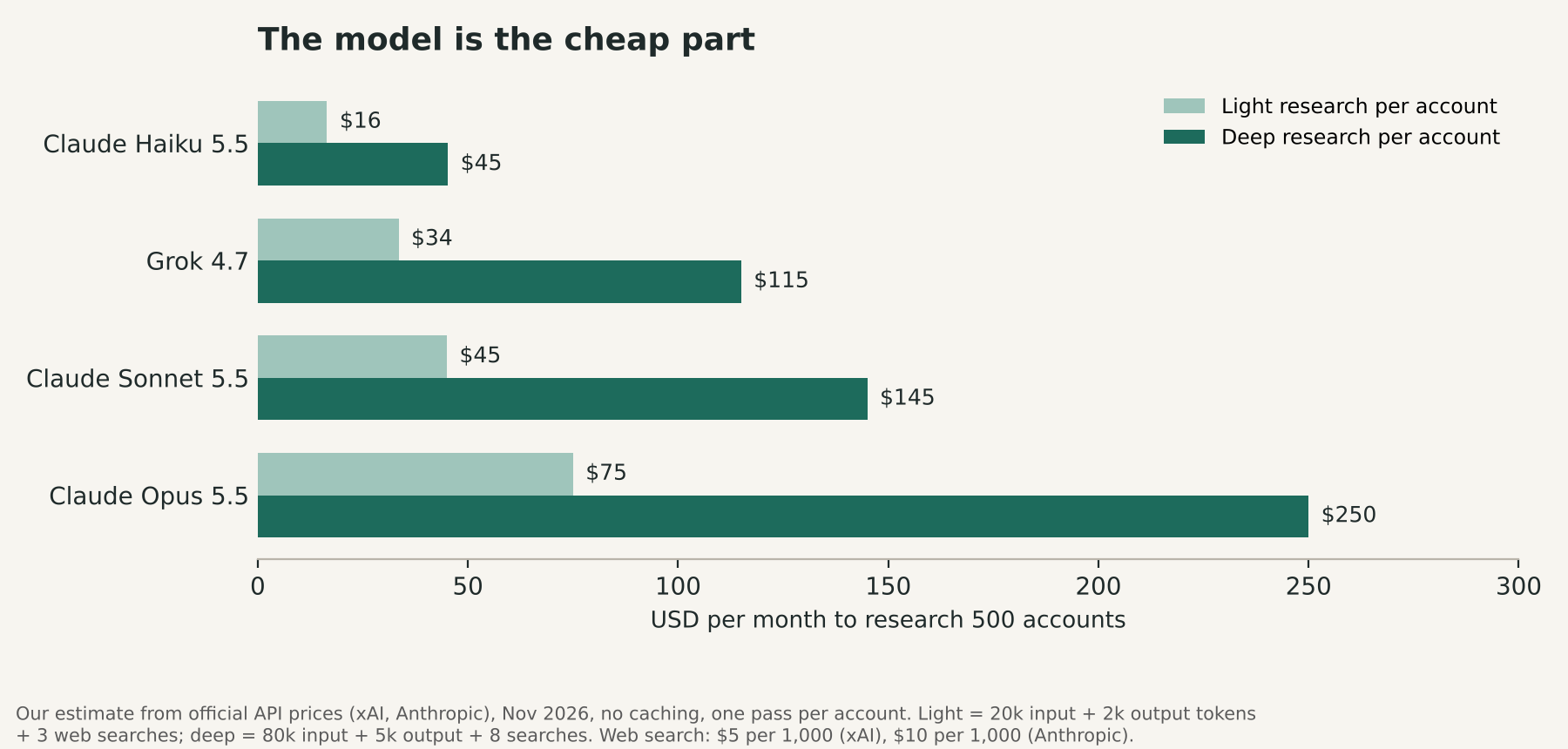
The model itself costs far less. Using official API prices, researching 500 accounts a month costs about $16–$45 with Claude Haiku 5.5, $34–$115 with Grok 4.7 and $75–$250 with Claude Opus 5.5. Our assumptions per account, with no caching: light research is 20,000 input tokens, 2,000 output tokens and 3 web searches; deep research is 80,000 input, 5,000 output and 8 searches. The money in outbound goes to data, sending infrastructure and the people who check the work.
Where it breaks
- Wrong facts. AI-written personalization can include incorrect company facts, outdated information or claims you can't trace to a source. A message that sounds personal and gets a fact wrong does more harm than a plain one. That's why every claim should be checked before it reaches a prospect.
- Deliverability. Gmail expects bulk senders to stay under 0.3% spam complaints. An agent that can send more burns domains faster.
- LinkedIn. Its terms ban third-party tools that automate activity on the platform. In December 2025 LinkedIn restricted Artisan's accounts; Artisan was reinstated after removing references to LinkedIn from its website and reviewing its data vendors.
- Security. OpenClaw, a popular open-source agent, had a serious one-click remote code execution vulnerability (CVE-2026-25253) and documented cases of malicious third-party skills. Agents with access to your inbox and accounts need the same scrutiny as any other system with those permissions.
What the credible setups have in common
Across the vendor templates and the best-documented builds, the same pattern shows up: research with a source for every claim, rules that decide who gets contacted, AI drafts, and a person approving before anything is sent or written to the CRM.
Human approval isn't a stopgap until models improve. One wrong outbound message can cost a domain, a LinkedIn account or a reputation, while a review costs seconds.
A simple test before you buy
Run the agent on 50 of your own target accounts and check every claim against its source. Count the wrong facts, the wrong people and the drafts you'd send unedited. Then decide how much of it you'd let run unchecked.
Method and sources
Desk research, checked 4 November 2026. Product behaviour comes from official templates. Results come from the companies' own publications and are self-reported. Model costs are our estimate from official API prices, with the assumptions above.
Sources
- xAI GTM Prospecting bot
- xAI Grok Bot guides
- SaaStr, 6 months of AI SDRs
- SaaStr, AI agent playbook for GTM (Oct 2026)
- SaaStr, should I run 20 AI agents?
- Instantly 2026 benchmark
- Salesforge pricing
- 11x Alice pricing
- xAI API pricing
- Anthropic pricing
- TechCrunch on Artisan
- Google sender guidelines
What we don't know
There's no controlled comparison of fully automated vs human-approved outbound; Grok Bot's pricing and usage limits aren't officially published; 11x's own pages show three different starting prices.
See how we build outbound with sources and approval