Method
Signals over volume: automate the sales motion that already works
You already sell. The question is not how to do more of everything, but how to find what works in your own data, turn it into signals and rules, and automate it one stage at a time.
Checked 21 November 2026 · By Tim, Seamline · 6 min read
The problem with outbound volume over sales signals
A company that already sells usually hits the same point. Growth slows, the team is busy, and the obvious answer is more: more leads, more outreach, more tools, maybe an AI SDR.
But more activity only helps if you know what to do more of. In many teams, the motion that actually wins is informal. A senior rep knows which accounts are worth a call. Customer success knows which customers are about to expand. Nobody has written it down, so nothing can be measured, taught or automated.
Automating before that is clear doesn't scale what works. It scales the noise around it.
Mine CRM and billing data for what already works
Start with your own systems, not a new data provider.
| Data source | What it can reveal |
|---|---|
| Closed-won deals | Which segments, company sizes and roles buy, and what was happening at the account at the time |
| Closed-lost deals | Where you lose on fit, timing or price |
| Expansions and upsells | Which customers grow, and what came before the expansion |
| Churned customers | Which accounts were never a good fit, and the early signs |
| Support conversations | Recurring problems, and which ones lead to a bigger purchase |
| Billing history | Customer value, payment behaviour and revenue stability |
This only works if the records can be trusted. If the same customer exists three times, or CRM revenue doesn't match billing, fix that first.
The goal is one written pattern per motion, short enough to check:
"We win with [type of company] when [event] happens, because [problem], usually through [role]."
You may find more than one: one pattern for new customers who look like your best ones, and another for expansion inside accounts you already serve. Write both down separately. They need different signals.
Turn buying patterns into first-party sales signals
A signal is an observable event that matches a moment when customers have bought from you before. Some are external, like a new location, a leadership hire or a job post for a role your product supports. Others are already in your own systems: a renewal date approaching, seat usage near its limit, a spike in support tickets, or a past champion at a customer who has moved to a new company.
Signals point both ways. The same kind of event can open a conversation at one account and warn of risk at another. A leadership change at an existing customer, an overdue invoice or a surge in tickets is a reason to check in before renewal, as in our renewal-risk use case and customer health score.
Every signal answers four questions: what happened, where the evidence is, when it happened, and why it matters to the problem you solve.
| Field | Illustrative example |
|---|---|
| Account | Example Logistics |
| Signal | Hiring a Head of Revenue Operations |
| Source | Public job listing |
| Observed | 12 November 2026 |
| Review after | 30–60 days |
| Why it matters | If your won deals show the same pattern, a new RevOps leader may review CRM and tooling in their first months |
| Confidence | Medium |
Two rules keep it honest. A signal without evidence is not a signal. And a signal is a reason to look, not proof that the account wants to buy: intent and timing signals help you prioritise, but they don't replace qualification.
The 4 stages of sales motion automation
We use four stages. Each has a result to hit before the next one starts.
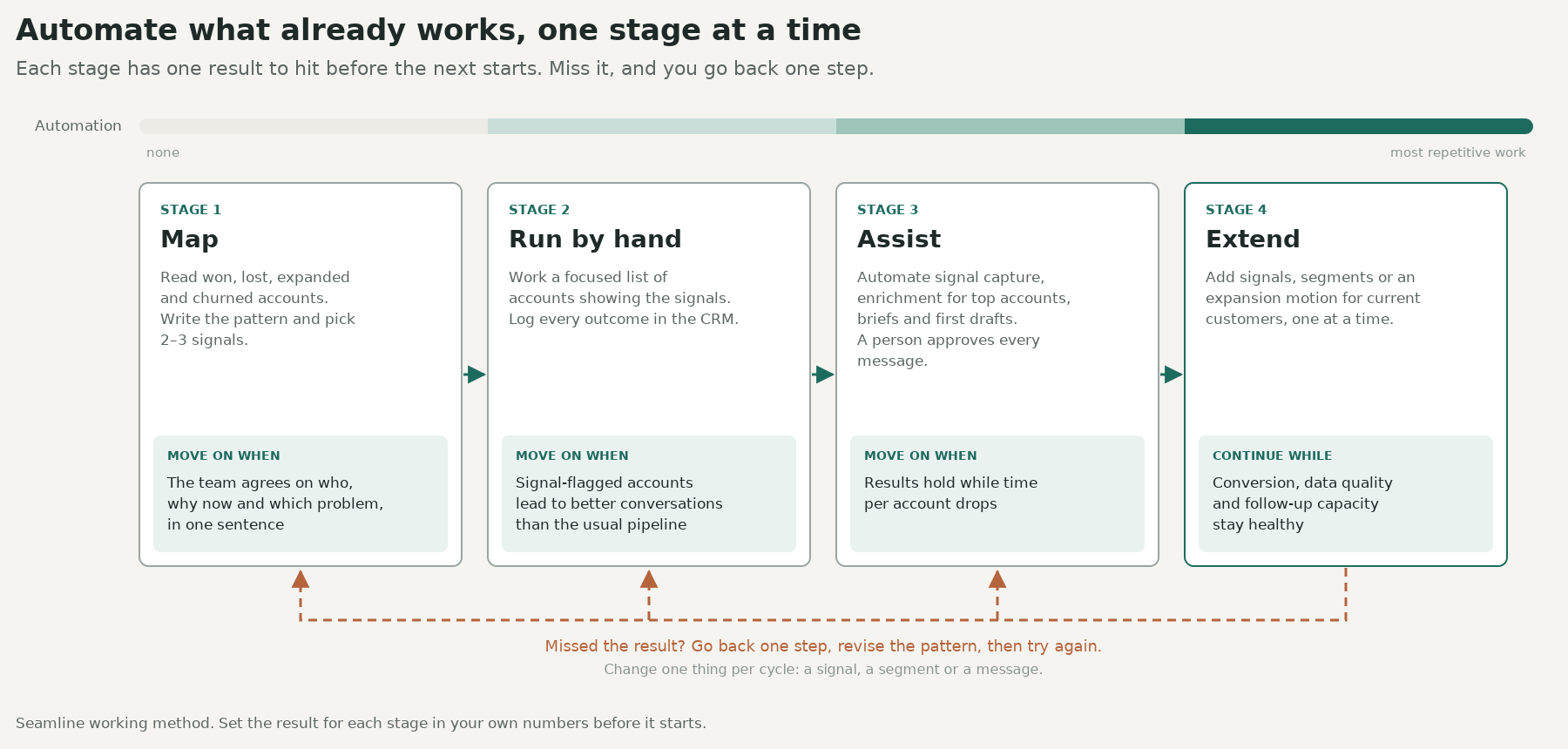
- Map. Analyse won, lost, expanded and churned accounts, write the pattern and pick 2–3 signals. Move on when the team agrees on who, why now and which problem, in one sentence.
- Run by hand. The team works a focused list of accounts that show the signals, and logs what happens in the CRM. Move on when signal-flagged accounts lead to better conversations than the usual pipeline.
- Assist. Automate the repetitive parts: signal capture, enrichment for the top-tier accounts, account briefs and first drafts. A person still approves every message. Move on when results hold while time per account drops.
- Extend. Add signals, segments or an expansion motion for existing customers, one at a time. Continue only while conversion, data quality and follow-up capacity stay healthy.
If a stage misses its result, go back one step and revise the pattern before adding more automation. This is how we build signal-based outbound for clients. Set each result before the stage starts, in your own numbers. The right thresholds depend on your deal size, sales cycle and market.
Measure each setup, change one thing at a time
Review results regularly by signal, segment, role and message. Then change one variable per cycle: drop a signal that doesn't lead to useful conversations, tighten a segment, or rewrite a message. Change three things at once and you won't know which one worked.
Over time the system answers the question that matters: which signals reliably lead us to the right conversations? That is what makes it smarter, not just more automated.
When to add volume
Add volume when the process has earned it. That means the pattern holds over several review cycles, the team can follow up on what comes back, and the data behind the signals is reliable. Until then, more volume only finds out faster that something doesn't work.
Summary: build the sales motion before automating it
Growing a company that already sells doesn't start with a bigger outbound operation. It starts with writing down what already works, testing it as signals, and automating each part once it has proven itself.
Method and sources
This is Seamline's working method, developed through client work on CRM data, billing and signal-based outbound. It is a method, not a claim that every stage produces the same results in every business. The signal record is an illustrative example, not client data.
Sources
What we don't know
Which signals matter, how long they stay relevant and what counts as a good result depend on your industry, deal size and buying process. They should be tested, not assumed.
At Seamline, that is how we build commercial systems: understand the data, define the signals and rules, and automate what has earned it.