Cost breakdown
Clay alternatives: when building your own n8n workflows makes sense
Clay Growth costs $495 a month. A custom n8n setup can cost much less in tools, but what happens when you include maintenance, API costs and the initial build?
Checked 4 November 2026 · By Tim, Seamline · 6 min read
Why teams look for Clay alternatives
Clay changed its pricing in March 2026. Billing is now split into data credits (paid data from providers) and actions (platform work). Three things changed for lean teams:
- CRM sync, the HTTP API and webhooks are on Growth only, at $495 a month or $446 billed annually. Launch ($185, with 2,500 data credits and 15,000 actions) can't push to HubSpot or receive webhooks.
- Your own API keys still cost actions. You can connect your own keys on every plan, but each run uses one action.
- Actions can't be topped up. Data credits can, at a 30% premium. Run out of actions and you move up a tier.
Clay says 90% of customers will never hit an action limit, and that data got 50–90% cheaper. Both can be true and still leave a small team paying $495 a month mainly for the sync.
If you only need contact data, our enrichment cost comparison covers that. This post is about the layer around the data: who runs the steps, writes to the CRM and fixes it when it breaks.
The same flow, three ways
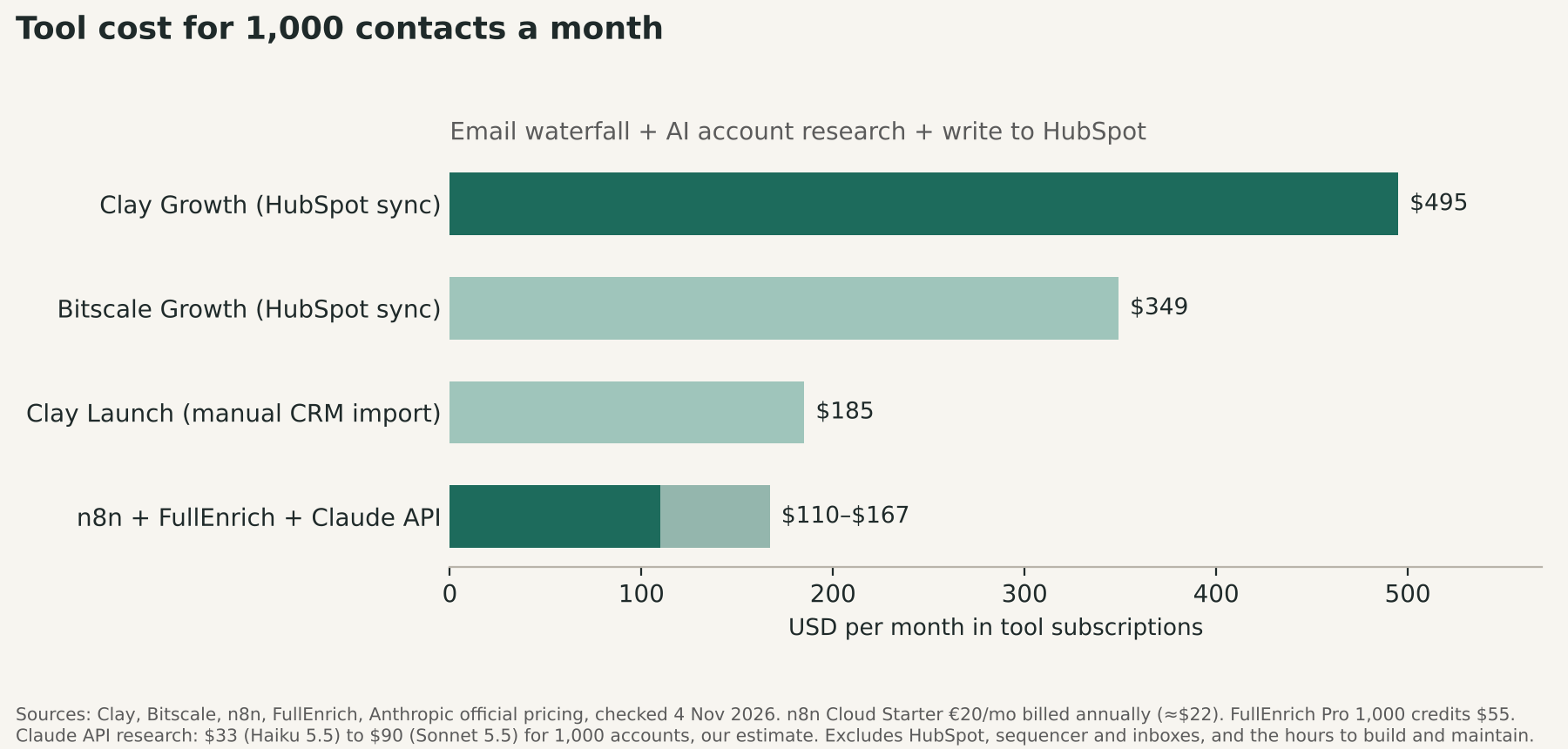
The scenario: 1,000 contacts a month, three steps per contact. Find a verified work email, research the account with an AI model, and create or update the record in HubSpot. No mobiles.
| Clay Growth | Clay Launch | n8n + APIs | |
|---|---|---|---|
| Orchestration | Included | Included | n8n Cloud Starter, €20/mo billed annually (≈$22) |
| Email data | 6,000 data credits included | 2,500 data credits included | FullEnrich Pro, 1,000 credits: $55 |
| AI research | Claygent or your own key | Claygent or your own key | Claude API: ~$33 (Haiku 5.5) to ~$90 (Sonnet 5.5) |
| Write to HubSpot | Native sync | Manual CSV import | n8n's HubSpot node |
| Tool cost per month | $495 | $185 | ~$110–$167 |
Your HubSpot seats, sequencer and inboxes cost the same in every column, so they're left out.
Other workbenches sit in between. Bitscale Growth costs $349 a month and includes two-way HubSpot sync. Databar Build costs $99 and lists bi-directional HubSpot sync. Make or Zapier with FullEnrich work like n8n: cheap in tools, and you build everything yourself.
The part most comparisons leave out: maintenance
You replace Clay's platform subscription with a smaller orchestration subscription and separate data and AI providers. You also take ownership of the integration, and that takes someone's time:
- API limits. HubSpot allows 100 requests per 10 seconds on Free and Starter. At 1,000 contacts a month that's easy to stay within, as long as writes are batched and retried properly.
- Breaking changes. n8n 2.0, released in December 2025, came with a list of about 25 breaking changes.
- Provider quirks. BetterContact's documentation, for example, warns that requests aren't idempotent, so an automatic retry of a request that already went through gets charged twice.
- Silent failures. In a 2026 practitioner survey (n=228), integration breakage was the top frustration, with leads stuck in a dead queue after an overnight failure. It's a self-published survey, so treat the ranking as indicative.
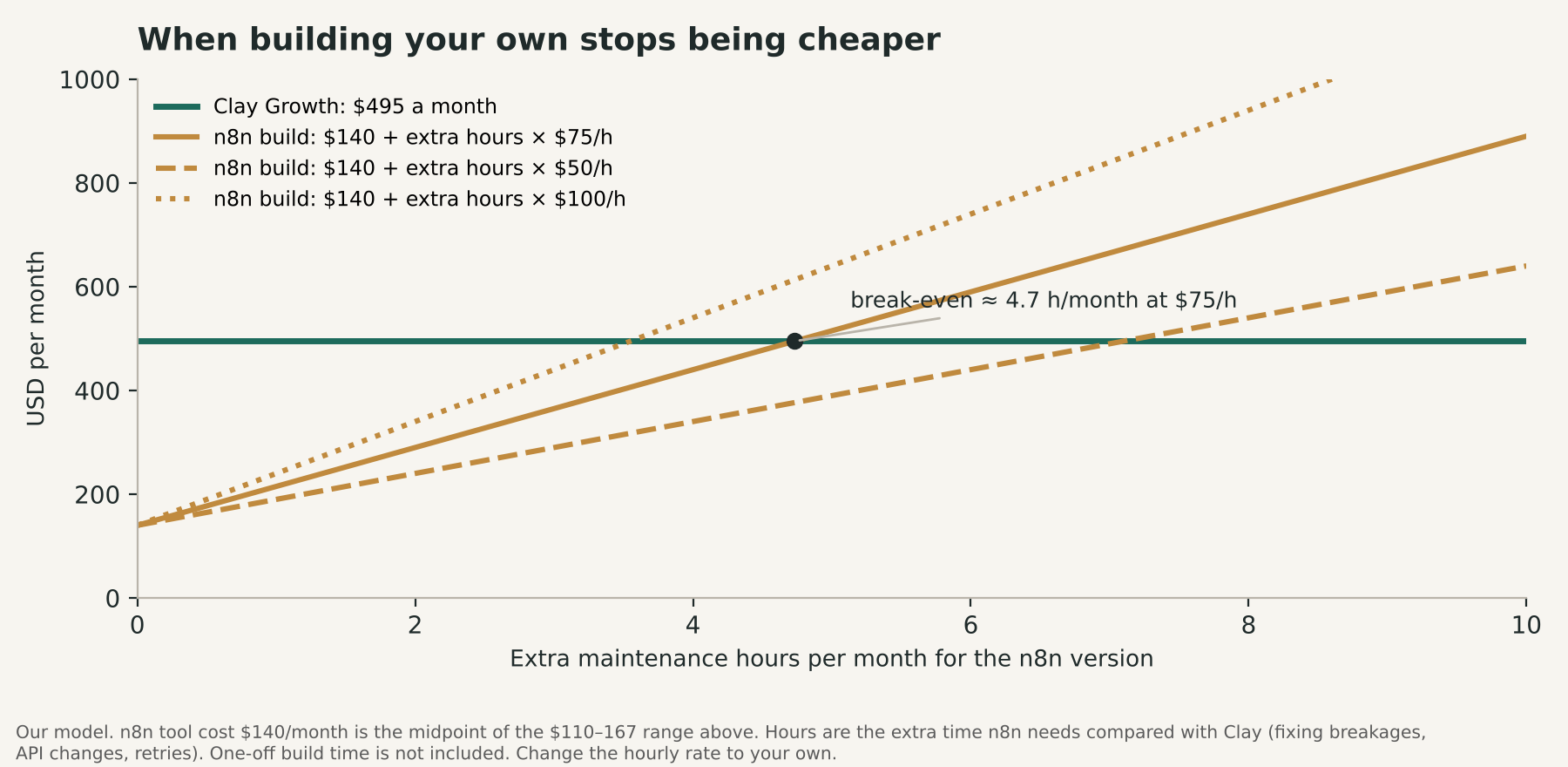
The arithmetic is simple. The n8n version saves about $355 a month in tools ($495 minus a $140 midpoint). At $75 an hour, that pays for 4.7 extra hours of maintenance a month. At $50 an hour it's 7.1 hours, and at $100 it's 3.6. Past that point, Clay is cheaper.
This is a recurring-cost comparison, not total cost of ownership. Say the build costs €3,000 (about $3,240) and the n8n version needs two extra hours a month at $75. It saves $205 a month net, so it pays for itself after about 16 months. A cheaper build, higher volume or lower maintenance shortens that. A fragile build stretches it.
When to stay on Clay
- People without a technical background need to change columns, providers or filters themselves.
- You're still experimenting with what to enrich and which signals matter. Clay is faster to iterate in.
- Nobody on the team wants to own error handling and API changes.
- You use many different providers and want one bill.
When a custom build makes sense
- The logic is specific to your business: written scoring rules, evidence with a source and date for every signal, a human approval step before anything is written to the CRM.
- Someone already owns your integrations, so the maintenance hours are small or already paid for.
- Volume is growing, and you'd rather pay per credit than per platform tier.
- You want the workflows, rules and data in your own accounts.
A middle path many teams miss: Clay Launch with your own API keys and a weekly CSV import to HubSpot. For a team that reviews its list weekly anyway, the manual step costs minutes, and the bill is $185 instead of $495.
A note on n8n's licence
The self-hosted n8n Community Edition is free under the Sustainable Use License. It allows internal business use and explicitly allows consultants to build and maintain workflows for a client, including on the client's own infrastructure. What it doesn't allow without a separate agreement is hosting n8n so that customers log in and use it, or embedding it in a product you sell.
Method and sources
Prices checked 4 November 2026 on official pages. The n8n price is the annual-billing price shown on its pricing page; monthly billing costs more. Assumes the workflow runs in batches and stays within n8n Starter's 2,500 monthly executions. AI research costs are our estimate from official API prices: 20,000 input tokens, 2,000 output tokens and 3 web searches per account, no caching; search results add input tokens, so real costs can be higher. The maintenance and payback model is ours: the hourly rate, hours and build cost are inputs to change, not measurements.
Sources
- Clay pricing
- Clay's new pricing (Mar 2026)
- n8n pricing
- n8n licence
- n8n HubSpot node
- n8n 2.0 breaking changes
- FullEnrich pricing
- FullEnrich API rate limits
- Anthropic pricing
- HubSpot API usage limits
- Bitscale pricing
- Databar pricing
- GTME Pulse survey
What we don't know
How many hours your version will need, which depends on how many providers and edge cases it handles; whether Clay's included credits cover your exact mix of lookups; n8n's monthly-billing price on the day you buy.
Want to know which one fits your team before you build anything?